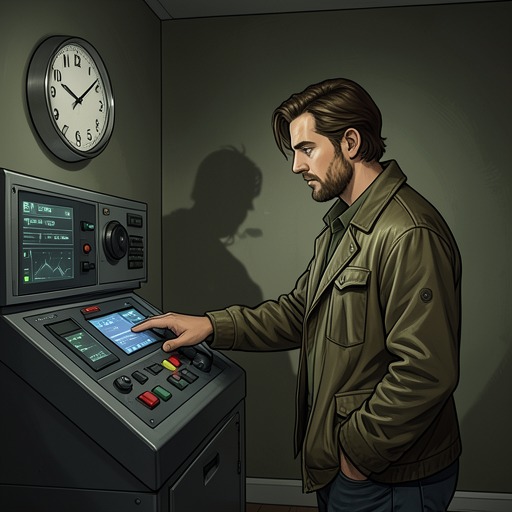
Twitchell's time displacement experiment sent Danie back to 1970
The Door into SummerDan Davis's displacement to 1970 turns a demonstration he dismisses as a hoax into an irreversible passage through time. Provoking Hubert Twitchell to activate the device, Dan arrives in the year he had hoped to reach—but only after a fall, in unfamiliar surroundings, with no assurance beforehand that the journey would work or that he could arrive safely.
The challenge to Twitchell
Before the displacement, Twitchell explains the device's consequence in precise terms: if he closes the pilot switch, Dan will be displaced exactly thirty-one years and three weeks. Dan refuses to credit the claim. He says that nothing will happen, even after Twitchell repeats the warning, and treats the machine's illuminated control board as theatrical scenery rather than evidence of a genuine discovery.
Dan's skepticism is not quiet disbelief. He tells Twitchell that the coin demonstration is a parlor trick, argues that any magician could do better, and says that the government has not suppressed Twitchell's report but filed it among material circulated for amusement. The scorn is calculated as well as dismissive: Dan recognizes Twitchell's wounded vanity as the remaining response that might make him act. Twitchell threatens to thrash him and orders him out, but hesitates before the button. Dan then calls him a faker and invokes Colonel Thrushbotham's verdict. That final taunt succeeds where the technical demonstration did not: Twitchell stabs at the control.
The displacement and its cost
The activation comes too late for Dan to stop it. As he begins to fall, he tries to shout a warning, but the displacement is already underway. His last thoughts are not triumphant: he regrets having gambled away everything and tormented an old man who had done him no harm, and he realizes that he does not know which direction the device is taking him or whether he can reach his destination at all. The moment turns his confident provocation into fear and remorse.
The arrival is abrupt and physical. Dan hits the ground after what he thinks is a fall of no more than four feet, but he is unprepared and collapses onto granite gravel and pine needles. The modest apparent distance makes the bodily shock sharper: whatever the device has done to time, the landing is not a controlled step into a new era. His disorientation is compounded by the people waiting there—a lean, bald man of about forty and a younger woman—who look at the fallen stranger with suspicion and surprise.
Recognizing 1970
Dan initially asks where he is, though he immediately understands that the more important question is when. The couple's bare, tanned bodies and their unfamiliar clothing tell him that he is not in 1970 as he remembers it, but neither is he still in 2001, where, he reflects, such public nakedness belonged on beaches. His mistaken first impression that he may have gone the wrong way gives way to a direct question about the year.
The man, more concerned with how Dan entered posted private property than with his confusion, asks whether a parachute caught in the trees and calls attention to Dan's clothes as a Mardi Gras costume. Dan's urgent question finally produces the confirmation: it is 1970. His relief is overwhelming. He has made it, and he believes he is not too late. To explain his bewilderment without disclosing the extraordinary cause, he tells the strangers that he suffers sudden attacks of amnesia and once lost five whole years; the man accepts that the experience would be upsetting and asks whether he feels well enough to answer questions.
Narrative significance
The event hinges on the gap between what Dan demands as proof and what he is prepared to believe. He has investigated Twitchell's rumor, inspected the control board, and watched a coin demonstration, yet dismisses both as stagecraft and institutional ridicule. Only after he attacks Twitchell's pride does the device operate. The skeptical performance thus becomes the means by which Dan crosses into the very possibility he denied.
The arrival also separates the act of reaching the past from the harder work of understanding it. Dan gets the year he hoped for, but the switch offers no safe landing, familiar setting, or immediate explanation to the people he meets. His relief at being in 1970 is real, yet it follows fear, a fall, and an improvised cover story. The displacement therefore marks both a practical turning point and a reversal in Dan's confidence: he has reached his intended time, but has entered it exposed, disoriented, and dependent on circumstances he cannot control.